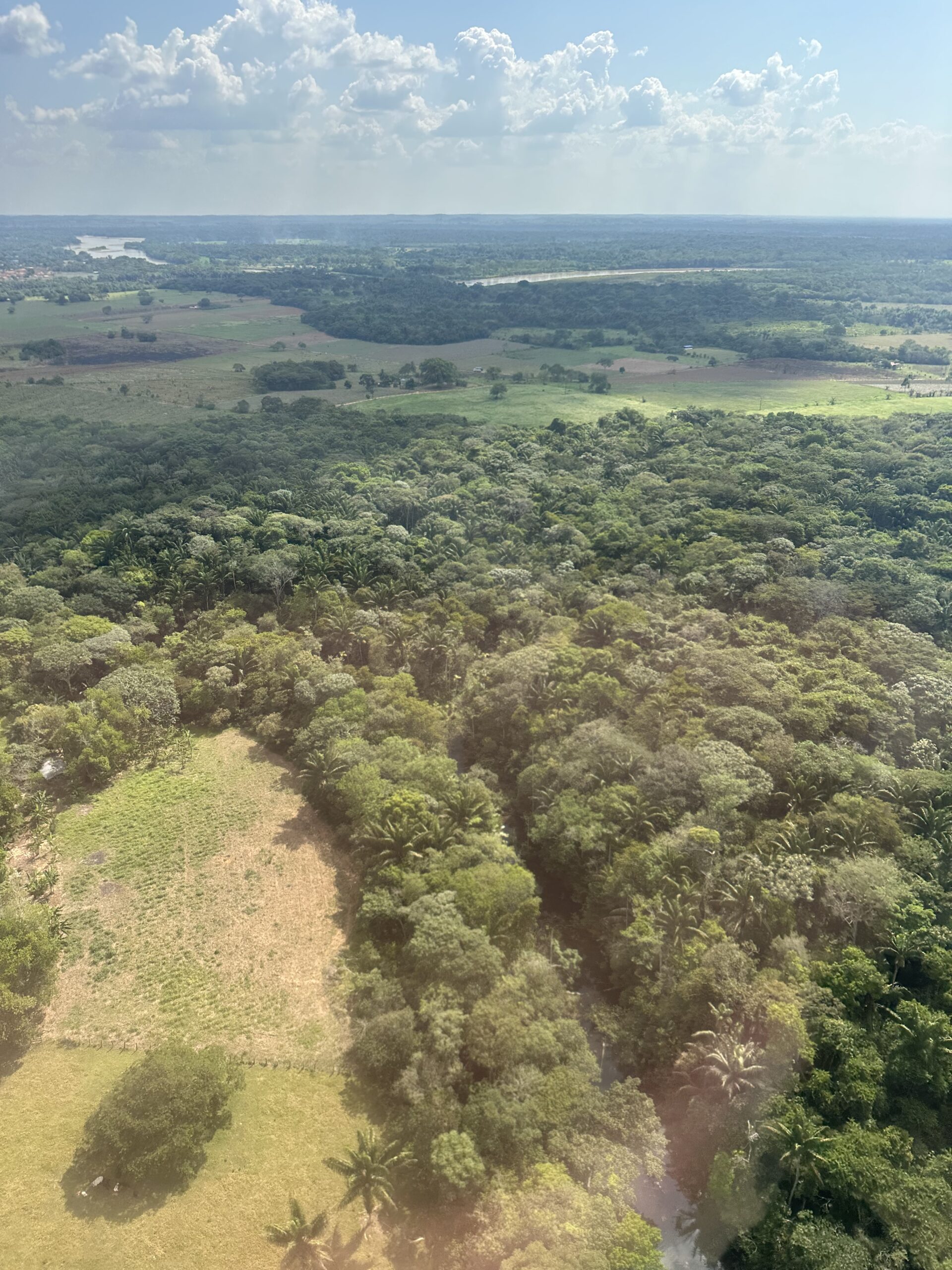
CARMEN DEL DARIEN, Colombia — As with so many crimes of war, what happened here in the dense, humid jungles of northwestern Colombia more than a decade ago might easily have been forgotten. Illegal militias forced hundreds of poor black farmers off their land, which politically connected businessmen then seized and turned into lucrative palm oil plantations.
U.S. Pact Is Motivation For Move, Critics Say
By Juan Forero
Washington Post Foreign Service
Monday, March 23, 2009; A08
The displaced farmers, well aware that the hundreds of thousands of people uprooted by Colombia’s long civil conflict rarely returned
home, thought they would never see their land again. But in this case, the government recently ordered nine palm oil companies to return
thousands of acres to the farmers, and the attorney general’s office is investigating the firms’ operators on accusations of homicide, land
theft and forced displacement.
The government, however, is motivated as much by self-interest as altruism, say human rights groups, which also charge that state
negligence coupled with aid for the palm oil companies helped facilitate the land seizures. President Álvaro Uribe’s administration
urgently wants a free-trade agreement with the United States, and Democrats on Capitol Hill have made clear that the pact is contingent
on human rights advances in Colombia, particularly for blacks and other marginalized groups.
“I think it’s directly linked, there’s no question about that,” Rep. Donald M. Payne (D-N.J.), a member of the Western Hemisphere subcommittee, said of the Colombian government’s attention to the land issue in the state of Choco. “I’m not so sure that these efforts by the government would be made had it not been for the external pressure that we’ve raised.”
The plight of Afro-Colombians has been of particular concern to the 42- member Congressional Black Caucus, several of whose members, including
Payne, have met with Uribe to raise their concerns. Some have also traveled to Choco, under heavy military guard, visiting areas mired in
poverty and violence.
Few in this country have suffered as much as Afro-Colombians, who make up more than 20 percent of Colombia’s 45 million people, the largest
black community in Spanish-speaking America.
Black Colombians, the descendants of African slaves, have endured mass killings, forced displacements and fighting on ancestral lands — the
hard reality of a simmering but brutal conflict involving deaths squads, Marxist rebels and drug traffickers. The Afro-Colombian population here in Choco, where the majority of people are black, suffers from an infant mortality rate twice the national average and a poverty rate topping 75 percent.
“The truth is, the Colombian government does not value us,” said Ligia Maria Chaverra, 68, a leader in this community in Choco state. “It has
always been that way.
The Uribe administration says it has done more for Afro-Colombians than any other government — and the efforts in Choco are held up as an example of the state’s commitment. Lawyers, social workers, agronomists, prosecutors and other specialists from various ministries have been deployed to this region, known as Uraba.
“This is a very important case for the government,” said Catalina Riveros, a lawyer from the Agriculture Ministry who has been working on the case. “We’re trying to get the lands that were taken from Afro communities.”
But the government’s portrayal of its role here, that of a tireless champion of poor blacks, sharply contrasts with the version that emerges from court documents and depositions by jailed paramilitary commanders and a former financial adviser to the largest palm oil company in this region, Urapalma.
Government investigators say that illegal, anti-guerrilla death squads that swarmed through in 1996 and 1997 worked with troops commanded by
Gen. Rito Alejo del Rio, who is now in jail on charges that include murder and collaborating with paramilitary groups. More than 100 villagers were slain, and as many as 3,000 farmers were forced to abandon 247,000 acres, a swath about a third the size of Rhode Island.
The palm companies then built roads through the forest and planted nearly 15,000 acres with African palm, which is used as a biofuel and in many other products. The few farmers who had individual titles to land were forced to sell. “They would say, ‘Sell, or your widow will,’ ” recalled one farmer, Eustaquio Polo Rivera, 40.
The community held most of the land under collective title, as permitted under a constitutional provision that gives special land rights to Afro-Colombians. Though collectively owned land cannot be sold, investigators and government officials said, the companies got around that obstacle by creating false titles and doctoring records.
Documents from the attorney general’s office and the nation’s controller obtained by The Washington Post show that state loans were used to bankroll the palm oil company operations. Urapalma received most of its start-up funding from the state, the controller’s office said, and the company accounted for 89 percent of the incentives provided from 2002 to 2006 through a rural development fund to companies in Choco.
Long-established palm oil businesses knew little about these companies. “Here, when you can’t see who the stockholders are, then you begin to wonder,” said Jens Mesa, who heads Colombia’s palm oil federation, Fedepalma. “When people say, ‘Don’t ask,’ it’s because it’s something shady.”
Court documents and depositions show that some of the companies had close links to illegal paramilitary groups that massacred villagers in a dirty war against leftist rebels. The commanders of those groups have since disarmed their forces and are offering testimony about their alliances with military and government officials in exchange for leniency.
The ties, according to records and the testimony of commanders, reached the top of Urapalma and another company, Palmas de Uraba, whose representatives met with Vicente Castaño, a feared commander who had publicly outlined his plan to cover the region with African palm.
Another jailed commander, Ever Veloza, told prosecutors that one of the men hired by the companies to “legalize” the land seizures was a paramilitary leader named Rodrigo Zapata, who was wanted in connection with hundreds of killings. Last April, in a scandal that rocked the country, Zapata helped organize a secret meeting at the presidential palace between top presidential aides and the emissaries of a jailed paramilitary commander.
“The investigations by the attorney general’s office are beginning to clear up the story of these companies,” said Victor Abramovich, head of an Organization of American States delegation that visited Choco and issued a report on the case. “I’m not saying that all the companies are tied to the paramilitaries, but there are some that are directly linked.”
Palm company officials accused of having ties to the paramilitary groups did not return calls, nor did Abelardo de la Espriella, a lawyer who represents Urapalma.
But a former manager and lawyer for Urapalma, Carlos Daniel Merlano, said Urapalma and the other companies thought the land had been acquired legally. He said the government did not tell the companies about the forced displacement of farmers. “If the company had known this land belonged to the Afros, no one would have invested in that land,” he said.
Three of the companies agreed to give back 3,200 acres, which the government turned over to the community last week. And some farmers, like Enrique Petro, have returned.
“This is the African palm they planted on my farm, illegally, without permission,” Petro said, as he offered a visitor a tour through a field of palm trees. “They killed families, sons, friends and neighbors to plant this palm, so this plant is stained with blood.”
The other companies, which hold about 39,000 acres with what the government says are false titles, have told government officials that they want to negotiate a deal.
“The government told them there was nothing to negotiate,” said Riveros, the Agriculture Ministry lawyer.
The case is now tangled up in the courts.
Here in Choco, there is skepticism, largely because some leaders here have been threatened and one, Walberto Hoyos, was killed in October.
“The criminal networks are still there,” said German Romero, a lawyer with a local rights group, Justice and Peace. “So they are afraid.”